
Somewhere in your company, there's a person who knows exactly why this buyer is going to market.
They know the current vendor missed a deadline last spring. They know who really makes the call. They know price matters, but not as much as getting it right this time.
That person is on your sales team. And most of the time, none of that makes it into the proposal.
The gap between the conversation and the page
Sales and the people writing the bid are usually working from two different sources.
Sales has the relationship: the calls, the coffee meetings, the side comments after the demo.
The bid team has the RFP document: the questions, the requirements, the scoring grid, the deadline.
When those two never meet, the proposal answers the document and misses the buyer. It's accurate. It's complete. And it sounds like it was written by someone who's never met them.
Why it happens
It's rarely anyone's fault. Sales is busy chasing the next deal. The bid lands with a deadline that's already tight. Writing starts right away because it feels like progress.
And the insight sales carries around is hard to hand over. It's not in the CRM. It's in their head.
What I learned doing this off the side of my desk
Earlier in my career, I worked on around 100 RFPs before there was a dedicated bid manager. Not as my full-time job. In between everything else.
The early ones took forever, and the hardest part wasn't the writing. It was chasing information. I'd send questions, wait, follow up, and start writing with half the picture.
What changed things was building a simple process for pulling information from sales before the writing started. Same questions every time, asked early. The proposals got sharper, and they got faster.
Try this: a 30-minute kickoff with sales
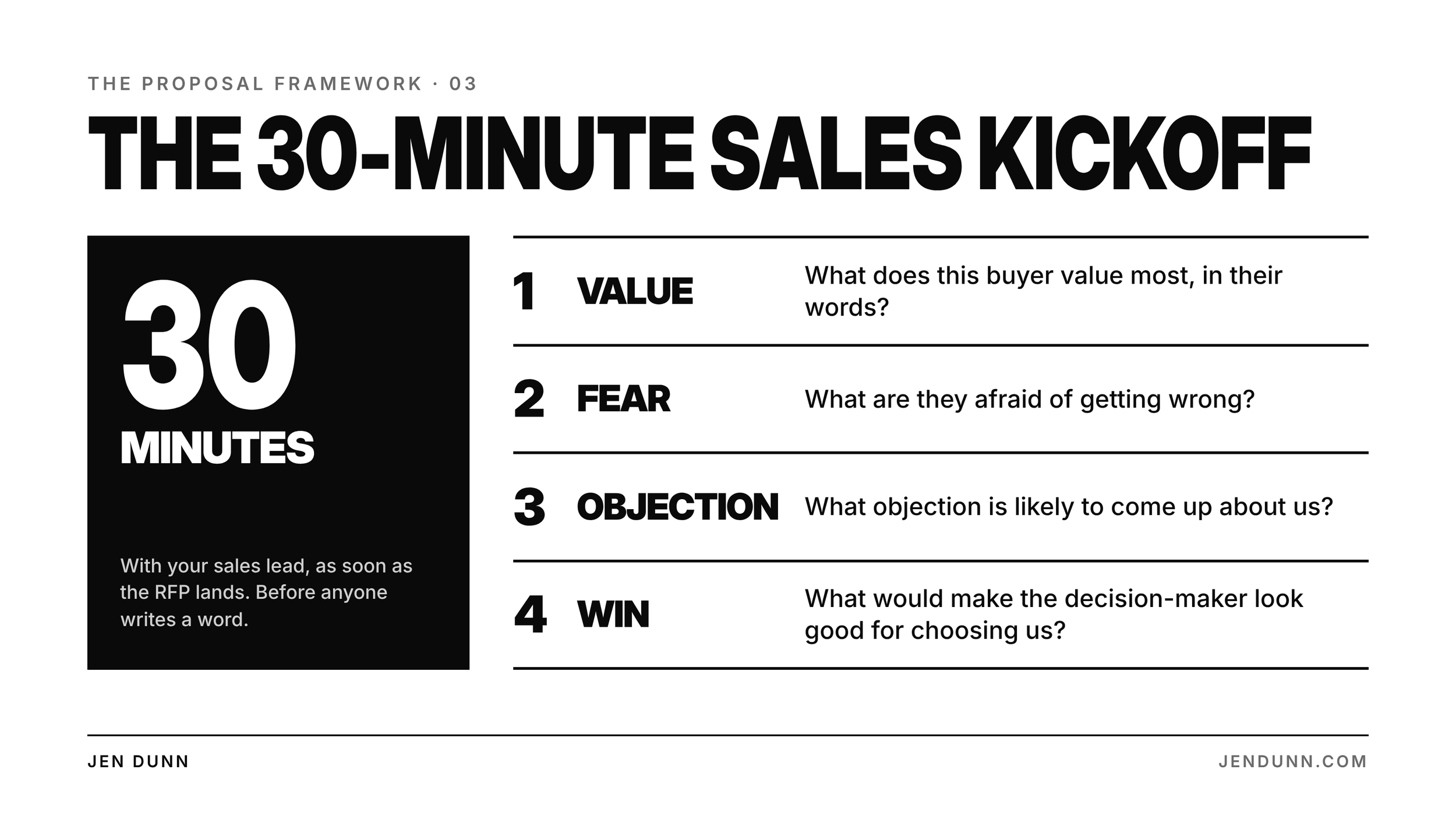
Book 30 minutes with your sales lead as soon as the RFP lands, before anyone writes a word. Ask four questions:
What does this buyer value most, in their words?
What are they afraid of getting wrong?
What objection is likely to come up about us?
What would make the decision-maker look good for choosing us?
Write the answers down and keep them beside you while you write. Every section should connect back to at least one of them.
Thirty minutes. That's often all it takes to turn a package into a proposal.
The bottom line
Your sales team has already done the research. It just hasn't been written down yet.
Get it out of their heads and onto the page, and your proposals will start to sound like you know the buyer. Because you do.
Not sure where your bids are slipping? The Bid Scorecard is 11 questions and 5 minutes. Take it now.
I write about how buyers decide and how to win more bids. Get one practical idea in your inbox each week. If this was useful, share it with whoever owns your next RFP.
– Jen