
Here's something nobody puts in the RFP: the person scoring your bid has a boss.
And if the vendor they pick falls short, they're the one who has to explain it.
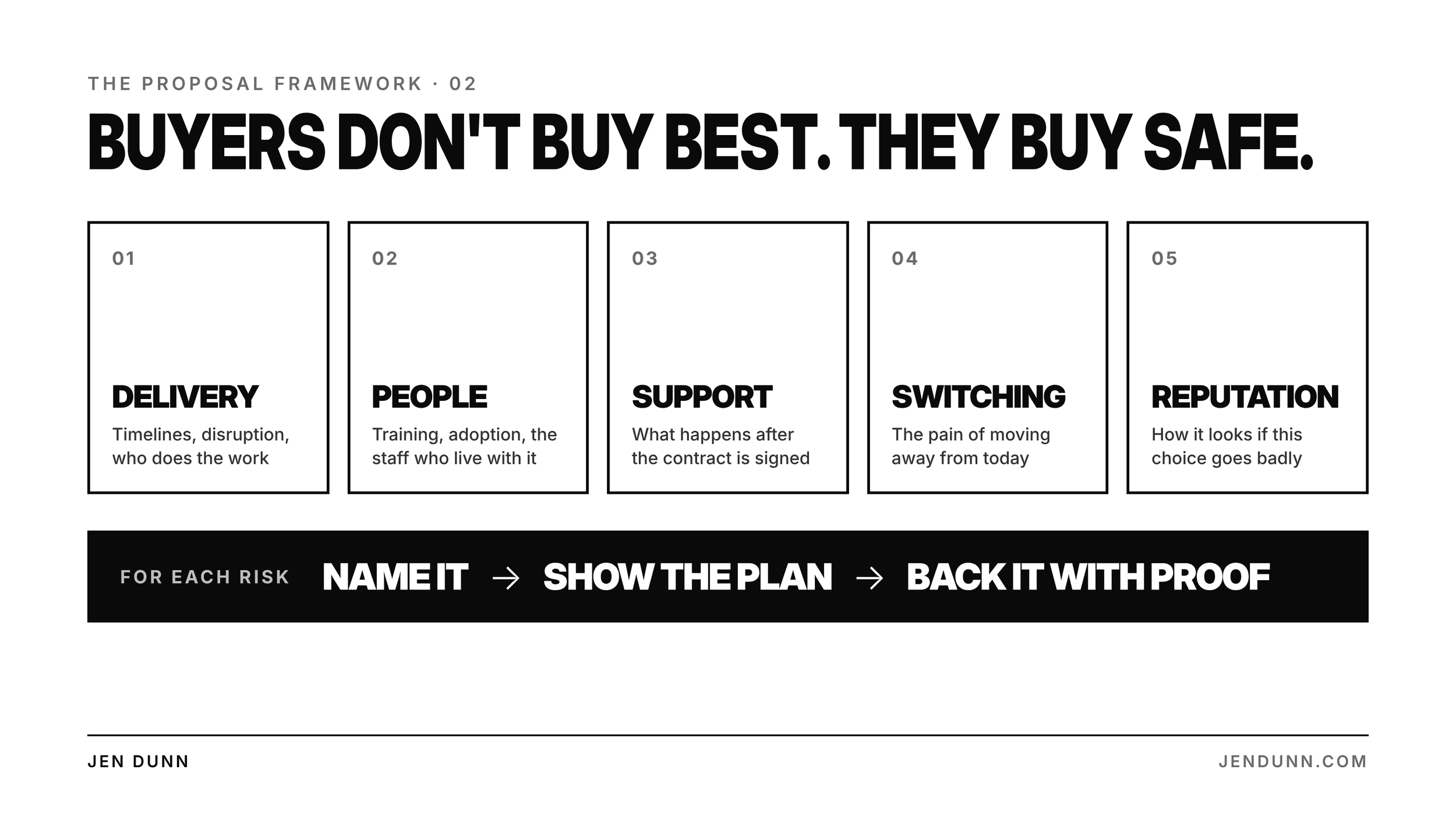
So evaluators aren't really asking "which one is best?" They're asking "which one can I defend?"
Best and safe aren't the same thing
Most proposals are written to prove they're the best. The most features, the strongest team, the most innovative approach.
But the evaluator is reading with a different question in mind: what happens to me if this goes wrong?
A project that runs late. A rollout that frustrates staff. A vendor who disappears once the contract is signed. Those are the things that keep buyers up at night, and they rarely show up in the scoring criteria.
When your proposal doesn't address them, the buyer fills the gap with worry. And worry usually picks the incumbent or the cheapest option, because those are easier to defend.
What it looks like when you get it right
Picture two bids. Both meet every requirement. One is a little cheaper.
The other names the buyer's biggest concern on page two (say, a tight rollout window before the school year) and lays out exactly how it will be handled: who owns it, what the timeline is, and what happens if something slips.
The second bid gives the evaluator something to say in the room: "They've thought about this. They have a plan." That's often enough to justify paying a bit more.
You're not just selling a solution. You're giving the evaluator a reason they can repeat to their boss.
Where risk hides in an RFP
→ Implementation: timelines, disruption, who does the work
→ People: training, adoption, the staff who have to live with it
→ Support: what happens after the contract is signed
→ Switching: the pain of moving away from what they have today
→ Reputation: how it looks if this choice goes badly
Sometimes the RFP points straight at these. A long section on transition or support is usually a sign of a past bad experience. Read those sections twice.
Try this on your next bid
Before you write, list the three ways this project could fail for the buyer. Not for you. For them.
Then make sure your proposal shows how you prevent each one. Name the risk, show the plan, back it with proof.
If you can't name the risks, that's a question for your sales team. More on that next week.
The bottom line
Buyers don't choose the best bid. They choose the one they feel safest saying yes to.
Make it easy to defend, and you make it easy to choose.
Not sure where your bids are slipping? The Bid Scorecard is 11 questions and 5 minutes. Take it now.
I write about how buyers decide and how to win more bids. Get one practical idea in your inbox each week. If this was useful, share it with whoever owns your next RFP.
– Jen